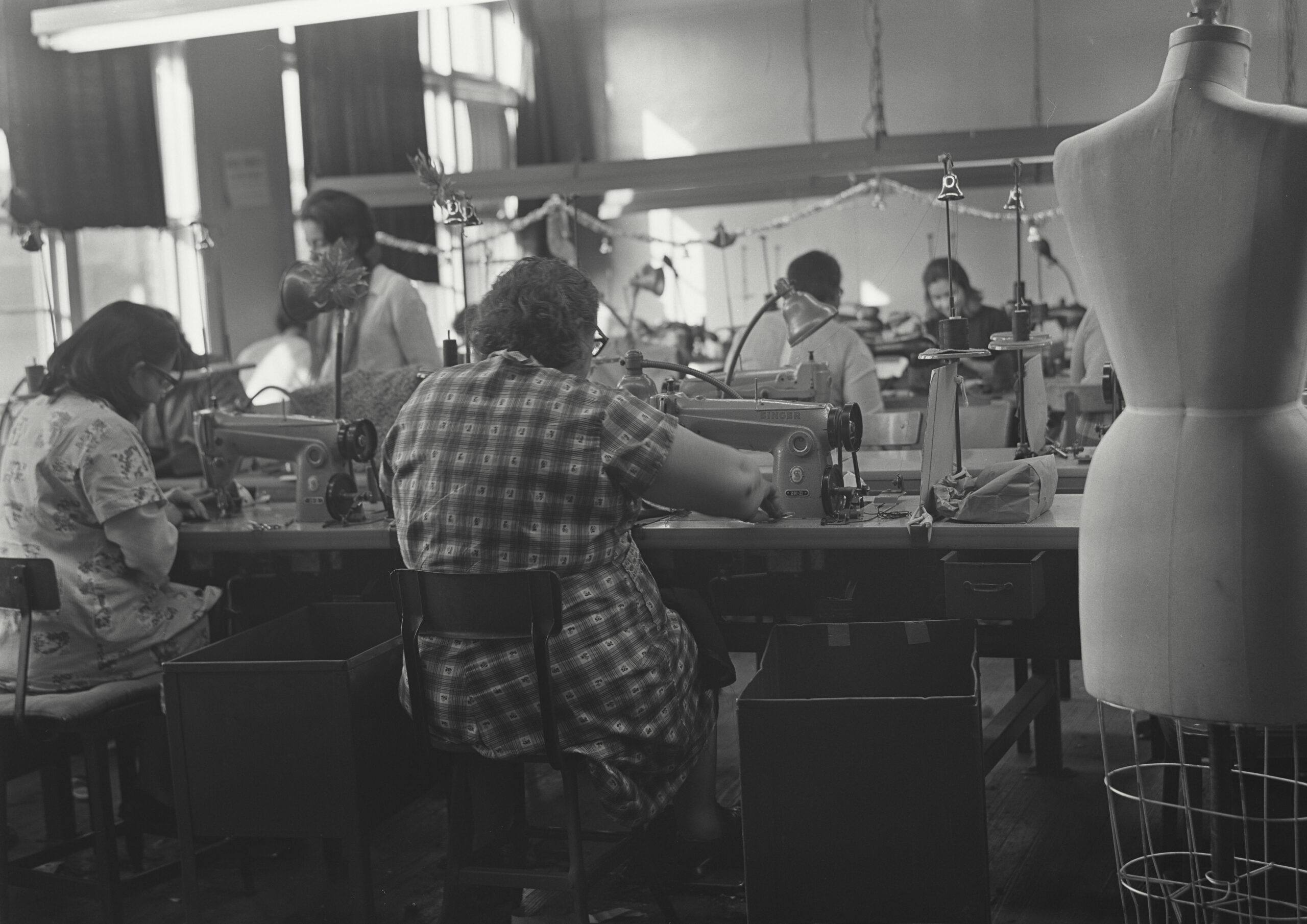
When we talk about solving fashion’s overproduction problem, the conversation almost always turns to forecasting. Smarter algorithms, made-to-order drops, AI that predicts demand down to the SKU — all of it aimed at the same goal: make less of what won’t sell. That instinct is right, and the work matters. But it treats overproduction as a math problem, something to be predicted away, when it’s just as much a problem of distance.
Fashion’s supply chains stretch across the world. A garment might be designed in one country, its fabric milled in another, cut and sewn in a third, then shipped halfway around the world to be sold — a system built over decades around one priority: the lowest possible unit cost. And that distance sets the terms. Long lead times force you to commit to large quantities months before you know what the season wants. High minimums push you to order more than you need to hit a price. The model rewards guessing big and early, and guessing wrong, at scale, is where waste is born. You can refine the forecast endlessly; the math still pulls toward excess.
The pandemic was the moment a lot of the industry saw what all that distance actually cost. Supply chains this long and this dispersed proved slow, fragile, and almost impossible to course-correct once they were in motion. The lesson wasn’t only to forecast better. It was that production this far from the people buying it is structurally prone to making too much. And the pandemic turned out to be a preview, not a one-off. The volatility it exposed is now the baseline: tariffs shifting with the news cycle, trade routes redrawn overnight, sourcing plans that penciled out in fall unraveling by spring. Trade policy has climbed toward the top of the industry’s list of worries for the year ahead, and the brands feeling it most are the ones whose production sits furthest from where their clothes are sold. When the ground keeps moving like this, the gap between a decision and its consequences stops being a question of efficiency and becomes a risk you carry every season.
Which is what makes local production worth a serious look — not as a values statement but as a practical hedge. Producing closer to where you sell shortens that gap. A factory within reach can run smaller batches, reorder what’s actually moving, and turn a correction around in weeks instead of seasons. Proximity makes responsiveness possible, and responsiveness is what lets a brand produce against real demand instead of betting ahead of it.
The case for local manufacturing usually gets framed around heritage, jobs, and craft — all true, and all necessary to keep local production alive. But there’s a sustainability argument that sits right alongside them and deserves its own line: making things near where you sell them is one of the most direct ways a brand can make less and waste less. The true scale of overproduction is hard to pin down, partly because production volumes still aren’t widely disclosed, but the estimates that do exist are sobering. Somewhere between 80 and 150 billion garments are made annually, as much as a third of them never sold, and roughly 92 million tonnes of textiles are discarded each year. Producing to real demand is one of the few things that works on those numbers before a garment is ever cut.
This isn’t only an American story. The same logic holds wherever you make and sell. A designer producing for the U.S. market isn’t short on options at home, from Los Angeles to New York’s Garment District, where designers, sample rooms, and suppliers still cluster within blocks of one another. A label in the UK has Hawick, the Scottish Borders town where the world’s finest cashmere and knitwear mills still sit within a few streets of one another, alongside the skilled knitters who staff them. In northern Portugal, the Ave and Cávado valleys hold one of Europe’s densest textile clusters — a near-complete supply chain from spinning to finishing, with each town specialized in its own craft and everything within an hour’s drive. The particulars shift from place to place, but the logic holds: the closer your production sits to your customer, the more control you have over how much you make. For a designer building a U.S. brand right now, that isn’t abstract. It’s the difference between absorbing the next tariff swing and being knocked off course by it.
Producing locally does take planning. Small-batch runs cost more per unit. Modern equipment is expensive, and the factories that have it want volume to justify it. Designers and manufacturers often can’t find each other, and when they do, the relationship rarely lasts long enough to settle into a rhythm. None of these are small problems, but none of them are unsolvable either, and designers increasingly aren’t facing them alone.
Those barriers also point to what proximity actually depends on. Local production only works if the skill is still there to use — the cutters, the sewers, the pattern-makers, the factories with the equipment and the knowledge to run it. That capacity is fragile. When the work goes elsewhere for long enough, the skill goes with it, and it doesn’t come back easily. So where the craft already exists, the move is to use it, and to invest in it before it disappears. Treating a local manufacturing base as something to be drawn on and sustained, rather than a cost to be minimized, is what keeps the option of making things nearby alive at all.
The CFDA’s own supply-chain programming starts from a simple premise: to support designers, the makers they rely on need support too. A label can only produce close to home if the factories are there to do it, and those factories only survive if designers keep choosing them. Programs like NY Forward help Garment District manufacturers invest in modern machinery and keep their capabilities current, and the new U.S. Fashion Manufacturing Fund will extend that same support to factories in apparel-producing regions across the country, from California to the Carolinas. The Local Production Fund works the other side of that equation. The pilot program supports brands that want to move part of their production from overseas or out of state to New York, pairing them with local manufacturers. It covers much of the cost of the first few seasons, when producing locally is most expensive and hardest to commit to. The point isn’t a one-time subsidy. It’s to give a designer and a factory enough runway to find their footing together, so a first order can become a lasting one. That’s how a single relationship turns into something an industry can be built on, one designer and one factory at a time.
For an independent designer, the takeaway is practical. Producing locally isn’t only a values decision or a slogan for the next campaign. It’s an operational one, with real consequences for how much you make, how fast you can adjust, and how much ends up unsold. The barriers are genuine, but they no longer have to be faced alone. The question worth sitting with is no longer whether local production is possible, but how much of what you make could be made closer to home, and what that would change about how much you need to make at all.