Inside the CFDA’s First SOURCING Sessions
September 10, 2026
Ria Chawla
The CFDA took its new partnership with FASHION by Informa to the SOURCING floor on Wednesday morning for two conversations about the relationships behind a brand’s finished product – between a designer and the factory that turns an idea into a sample, and between a brand and the technology partners helping it understand what that product is actually worth. Announced in July and running into 2027, the partnership is built to strengthen American design and fashion manufacturing and connect local brands and production partners to a global audience.
Exhibiting on the floor was a CFDA-curated group of New York manufacturers: Sepia NYC, Knit Resort, Dyenamix, Park Avenue International, Rainbow Leather, Panah Project, and M & S Schmalberg – covering leather goods, knitwear, dyeing and finishing, and handmade fabric flowers, all within a few subway stops of the designers who need them.
The two conversations delved into the value of producing locally, and how collaboration is redefining innovation in the fashion value chain.
The Case for Local Production
Alex Dabagh, CEO and Executive Director of Park Avenue International and a second-generation leather smith carrying the family legacy forward, joined Emilyn Edillon, CFDA’s Program Strategies Manager, to make the case for producing in New York. His factory has been making leather goods here since 1982, and is now among the oldest and last of its kind still operating in the city.
The session opened with the question every New York designer eventually faces: is local production worth the premium? Dabagh’s answer was yes – and that the standard math undervalues proximity. Being in your manufacturer’s backyard saves time, money and energy that never appear in a unit price. Quick fixes happen quickly. Travel compounds the farther production sits from the designer. And you can see who is making your product and how, a degree of control that is difficult to replicate at a distance and that matters most to younger brands who can’t afford a sampling round gone wrong three thousand miles away. There is also the cachet itself. “Made in New York” signals a level of craft and investment that buyers recognize on sight.
Beyond the logistics, what still lives here is knowledge. Technology has made parts of manufacturing more efficient, but the making still requires human hands, and New York remains home to artisans who know how a garment or bag is actually constructed. For designers, that reframes the Garment District from a service to be procured into a body of expertise to learn from – one within walking distance. The designers who take advantage of it brief better, push back better, and get closer to what they imagined.
Proximity also buys speed, and in New York it buys proximity to the moment itself. Being in the city where the culture is happening means seeing a trend form in real time; being next door to your factory means being able to respond to it. When the Knicks won, Park Avenue International moved fast enough to put a themed product into the market while the city was still celebrating – 75 bags sold the following week. That turnaround simply isn’t available to a brand producing overseas, and that agility to respond quickly is an advantage.
If proximity is the argument for New York, communication is what determines whether the relationship works. When asked what separates a great client from a difficult one, Dabagh offered some best practices. It comes down to the client’s preparedness at the first meeting – arriving with a clear idea down to the fine details. What makes it difficult, Dabagh said, is a designer who shows up and starts designing in the factory. The other common breakdown is changing materials close to production – what works on paper isn’t always what can be made, and the brands that get the best results are the ones flexible enough to work inside that gap. Dabagh described the dynamic less as a transaction than a matter of chemistry. “It’s like dating,” he said. “You’re in each other’s faces, texting, calling, emailing. You want to make sure it’s a healthy relationship.”
For Dabagh, the strongest argument is the ROI that can’t be measured in numerics: making something in New York means watching it travel from the factory floor to the storefront to the street, and there’s no dollar sign behind that feeling.
From Vendor to Innovation Partner
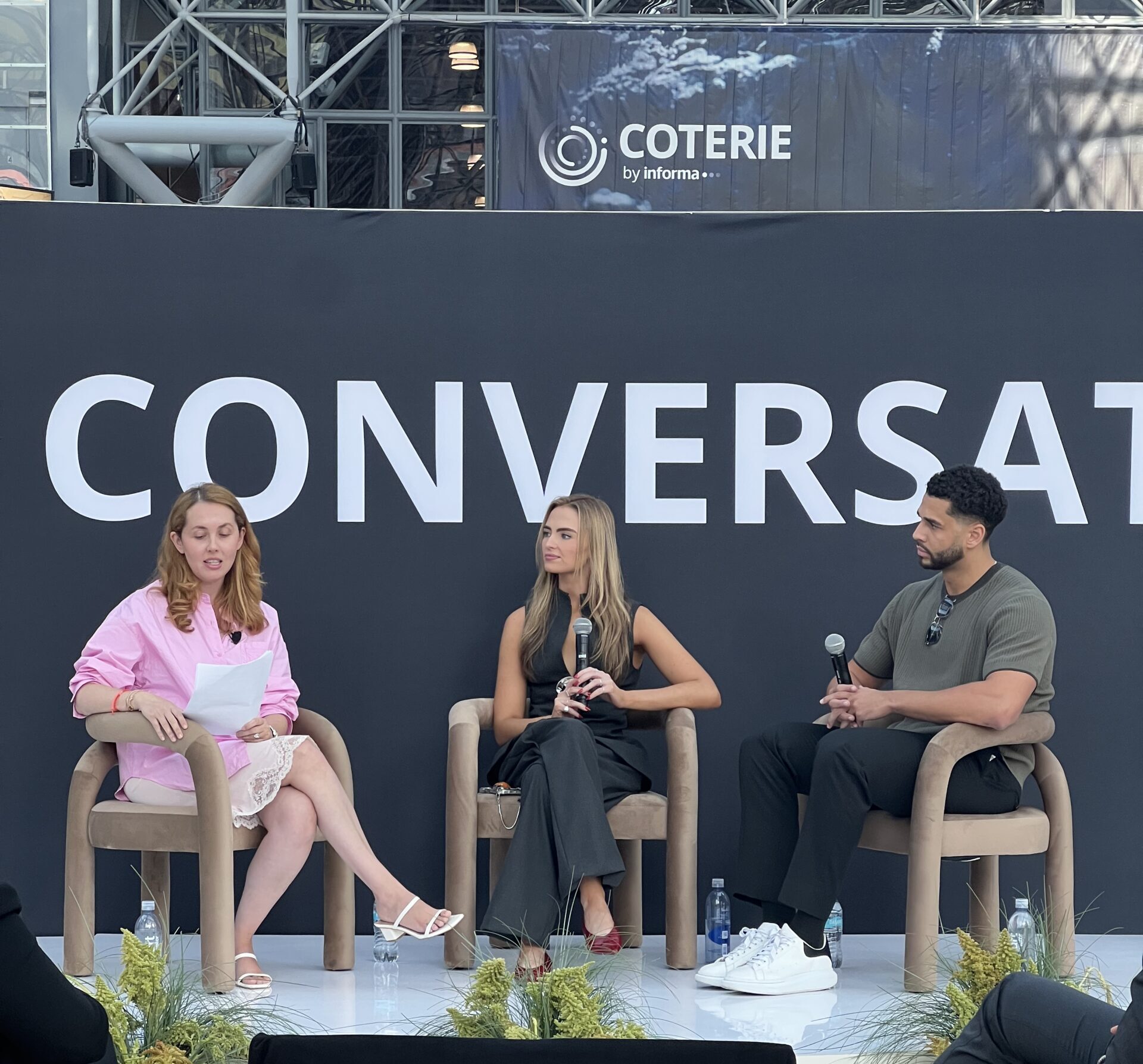
In the second session, CFDA Senior Director of Professional Development & Innovation Sacha Brown was joined by designer Kate Barton and her innovation partner, PILOT Co-Founder and CEO David Shedrick, to unpack how collaboration is redefining the fashion value chain. Brown framed the shift plainly: a vendor is someone you call once you already know what you want. An innovation partner starts with the problem itself, working alongside the brand to build toward a solution.
For Barton, collaboration began as necessity. No large team and no large budget meant partners with the right expertise had to fill the gaps – and what started as a workaround became the model. The approach is rooted in give-and-take, where both sides create value and both benefit from it.
Her Goldfish bag, which came to life during grad school before the brand existed, became proof of what a single product can do. Her advice to anyone chasing a viral moment is to work backwards from what genuinely excites you and is creatively interesting. “I wanted it to be something that started a conversation,” she said, “something people could not only get excited about, but talk about.”
What she couldn’t see was what that attention was worth – the gap between visible momentum and measurable value. That led her to PILOT. Shedrick argued the industry’s default metric, reach, tells only a small part of the story; the real questions are who is engaging, where their influence sits with the audience, what the earned media value is, and whether those same people stay engaged afterward. Transparent measurement is what allows co-investing partners to see returns, trust them, and come back for the next one.
For Barton, that data has become a planning tool rather than a report card. “We’re at this interesting stage that once we learn what we can optimize it can quickly change the direction of how we’re posting on social media or hosting events,” she said. “How much engagement, but also who is actually driving traffic and who do we want to be partnering with.”
Describing PILOT’s trajectory from conception to today, Shedrick pointed to bringing customers into the development process from the outset. “Our best ideas aren’t ours,” he said. “Our customers and our partners bring them to us.” PILOT Intelligence began as a partner’s request to measure the value of every individual guest attending a show or premium experience.
Asked where the barriers to collaboration between fashion and technology actually sit, Shedrick turned the question on his own industry. The biggest obstacles, he said, are usually on the technology side, and the fix is empathy. “Fashion is full of highly creative, highly intelligent people that know what they’re talking about,” he said. “So if they’re not adopting our software, we need to look in the mirror and say, have we built something that is worth adopting?”
Brown closed on the thread running through both conversations. “Great innovation starts with trust and being open – open to bringing people into the process earlier, open to having your ideas challenged, and open to the possibility that you might end up somewhere you didn’t initially expect,” she said. “You don’t necessarily need to have every answer or every capability within your own organization. Sometimes the most interesting work comes from finding the right people, bringing different expertise together, and figuring it out alongside one another.”