Exploring Next-Gen Textiles with Sci-Lume Labs
January 21, 2026
Emilyn Edillon
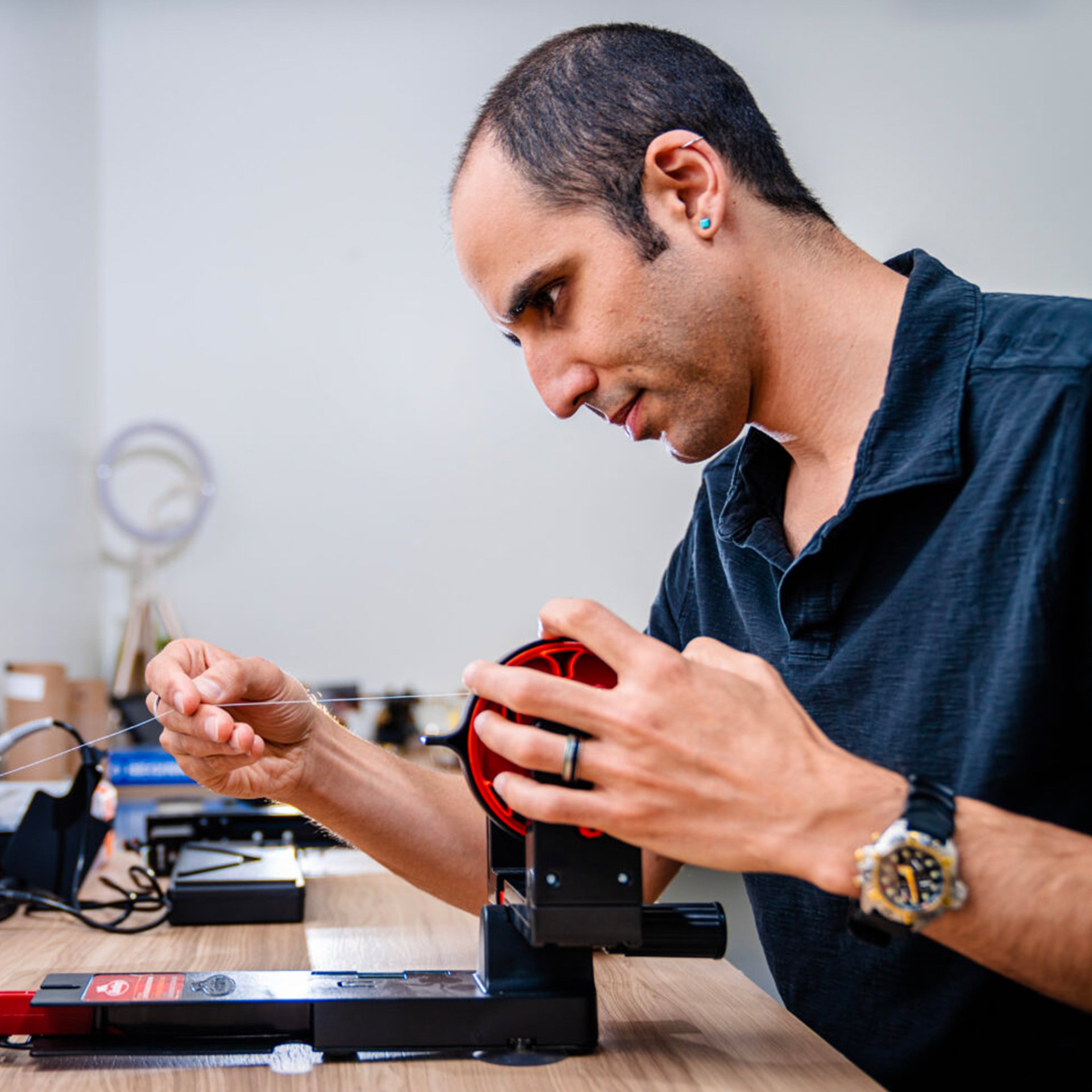
As part of the CFDA x Swarovski Foundation Re:Generation Innovation Fund, material innovator Oliver Shafaat is redefining what’s possible in fashion materials through Sci-Lume Labs.
Drawing on both scientific research and design experimentation, Sci-Lume Labs is developing Bylon™– a next-generation textile engineered for circularity and creative flexibility.
With early potential in knitwear and accessories, Bylon invites designers to co-create, not just source – exploring new textures, forms, and ideas that rethink how materials move from concept to craft.
What inspired you to found Sci-Lume Labs, and how did the idea for Bylon come to life?
I’ve always been a science nerd. As a kid, I was constantly taking things apart to make them work better—often breaking them, but that is how we learn. After completing my PhD at Caltech, I moved to Japan to join Spiber, a biotech company developing next-generation materials. This was my first exposure to fibers, and I fell in love with the physics, chemistry, and engineering behind man-made textiles, as well as the simple joy of holding a piece of yarn or fabric at the end of a long day in the lab.
As the only native English speaker on the technical team, I was also brought into business development conversations with fashion brands seeking sustainable materials. It was a revelation to learn that sustainability alone wasn’t enough to drive adoption—price was the major driver for interest and decision-making.
That is what led me to start researching for potential complementary solutions. I did what I was trained to do: I dove into academic journals—mostly at midnight after putting my toddler to bed—and pored over patents and conference papers for anything relevant. I needed a polymer made from biobased feedstocks, capable of biodegrading across environments, and offering property parity with conventional fibers. Most importantly, it had to integrate seamlessly into the existing textile supply chain, scale quickly, avoid increasing cost, and deliver the environmental impact that can help the world my kids will live in.
For those encountering Sci-Lume Labs for the first time, what is Bylon – and how does it challenge the way we think about materials today?
Bylon is a new yarn and fiber material that combines circularity with properties that have not been seen before on the market. For example, Bylon has moisture properties that are similar to cotton, which is unheard of in the synthetic space. We also maintain the traditional tunability and performance that is expected from mainstream synthetics. We are exploring in more detail some other interesting properties—elastic recovery, or comfort stretch, out to 15%, and ready dyeability which has knock-on implications for scope-three emissions. Bylon has everything that’s great about synthetic materials—performance, tunability, scale, and low cost—but without the emissions and waste associated with the mainstream synthetic materials we use today.
Given all the waste associated with our industry, and the world’s increasing reliance on synthetics to meet demand, Bylon can be a truly better alternative. I think the most important thing about Bylon is that it shows that new materials don’t have to come with compromise. These new materials can also challenge the paradigm of what a “synthetic” or “natural” fiber is, and enable not just sustainability but new forms of creativity within the fashion industry.
As a next-generation material still in its pre-commercial stage, what makes Bylon distinct from traditional textiles, and what applications and use-cases do you see for Bylon across fashion and design?
Something I find fascinating about the apparel industry is that performance can mean something different depending on the sector and application. Bylon is no exception. While we’ve already been able to characterize some of Bylon’s fundamental properties, there are still so many others to explore.
Identifying the right use case for Bylon requires close collaboration with designers, manufacturers, and brands. Our long-term goal for Bylon is to achieve widespread adoption across the industry, which is ultimately how we can deliver meaningful, positive impact. We also recognize that we’re not there yet. That is why I am excited to work with designers to understand where Bylon excels today, and where we can improve its performance to support broader integration across fashion.
How did receiving the CFDA x Swarovski Foundation Re:Generation Award help validate your work and accelerate your next chapter?
Receiving the CFDA x Swarovski Foundation Re:Generation Award has been a major validator for us—not to mention opening doors and helping to start conversations with potential designers, partners, and industry expert advisors. As a chemist, I have a good understanding of the technical side of fashion, but this award and the connections that have come with it have allowed me to better understand the fashion side of fashion. The award has given us the support of the CFDA and Swarovski Foundation, and with these powerful advocates we have been able to connect with industry experts and partners who are helping us bring our innovation to the world.
Mentorship is central to the Re:Generation program. How have conversations with mentors or industry leaders helped your approach as you scale your innovation from lab to market?
I strongly believe that we need to work together to solve the incredibly complex challenge of transitioning the fashion industry toward true sustainability. The mentors, factories, designers, and industry experts I’ve met through the Re:Generation program have been instrumental not only in expanding my understanding of fashion, but also in helping me grasp how the industry operates. This includes valuable guidance from Consultant Wendy Waugh of Golden Collective and Consultant Rob Price of Luxury Global Access. There is always a business dimension to consider, and learning what is required, not just from a product perspective but from a use-case perspective, has helped us refine our pitch to potential partners.
With this deeper understanding of the industry’s dynamics, we’ve been able to have more meaningful conversations and better articulate where our technology fits. It has allowed us to solidify a clearer path to market—both in the near and long-term.
Looking ahead, what creative collaborations excite you most as you invite designers to work with Bylon?
The program has introduced me to emerging designers and to the accessories sector—an area of the fashion industry I had not previously had the opportunity to engage with. I am really excited about potential collaborations in accessories, partly because these products can require far less material than garments, which makes them a practical starting point. More importantly, they offer a compelling opportunity to explore how Bylon can be used in new formats and how it works in conjunction with other materials. I am eager to work with designers, and to learn from them—to understand their creative process and gain first-hand insight into what goes into making a high fashion garment. I think this exchange of ideas will be essential for advancing Bylon’s potential, as well as deepen our understanding of how new materials can support and inspire design.
How do you envision these partnerships amplifying innovation and advancing sustainability meaningfully in the fashion industry?
I think that collaboration is essential to showing the power of working together for the greater good. With startups and innovation, risk-taking is inherent—and from what I have learned, the same can be said of fashion. Partnering with designers can demonstrate that the industry can innovate not only in aesthetic and form, but also in the materials themselves.
Bylon is just one of the many exciting new materials being developed, and by showcasing it alongside others, we can show that sustainability and fashion are not just compatible, but mutually reinforcing. My hope is that these collaborations will inspire designers to pick up Bylon and other new materials to help move the industry toward a more sustainable future.
Following your recent participation in the CFDA x Swarovski Foundation Climate Week panel discussion, what’s next for you in continuing the conversation around innovation and impact?
I would love to identify one to two designers with whom we share a strong vision and can build a truly productive collaboration. I also need to be pragmatic—we do not have the bandwidth to work with everybody. However, partnering with a designer and really exploring how Bylon can be used in a set of showcase pieces would be incredibly valuable. I know that I would learn a great deal from the process, and I hope that we could highlight the essential role that innovation and sustainability need to play in fashion’s future. We need to get this material out into the world: collaboration is critical, and I am eager to begin those conversations.
Sci-Lume Labs is now welcoming designers to explore small-scale collaborations using early-stage Bylon knitwear, yarns, or woven materials. Interested talents are encouraged to connect with Oliver [contact@sci-lumelabs.com] and his team to imagine what’s next.